
A few weeks ago, we made an exciting announcement that Swift Solar secured heterojunction (HJT) manufacturing assets and intellectual property from Meyer Burger.
Meyer Burger spent decades developing silicon manufacturing equipment and advancing silicon HJT technology. And now, we will integrate that capability with Swift’s perovskite technology to accelerate our path toward gigawatt-scale tandem manufacturing in the United States.
With this acquisition, we can begin building a domestic factory for HJT cells and modules. This allows Swift to manufacture next-generation perovskite tandems entirely in-house while also serving the growing market for American-made silicon solar cells.
So why focus on HJT when most silicon cell manufacturing today uses TOPCon technology?
Two of our co-founders, Tomas Leijtens and Giles Eperon, teamed up with Thomas Grosse and Marcel Koenig—who recently joined Swift Solar’s team from Meyer Burger—and laid out the case in a recent white paper, which you can read here.
We summarize their key points below.
In a perovskite–silicon tandem cell, the perovskite layer absorbs higher-energy photons, while the silicon layer captures lower-energy photons that pass through. The two layers operate together as a single electrical device.
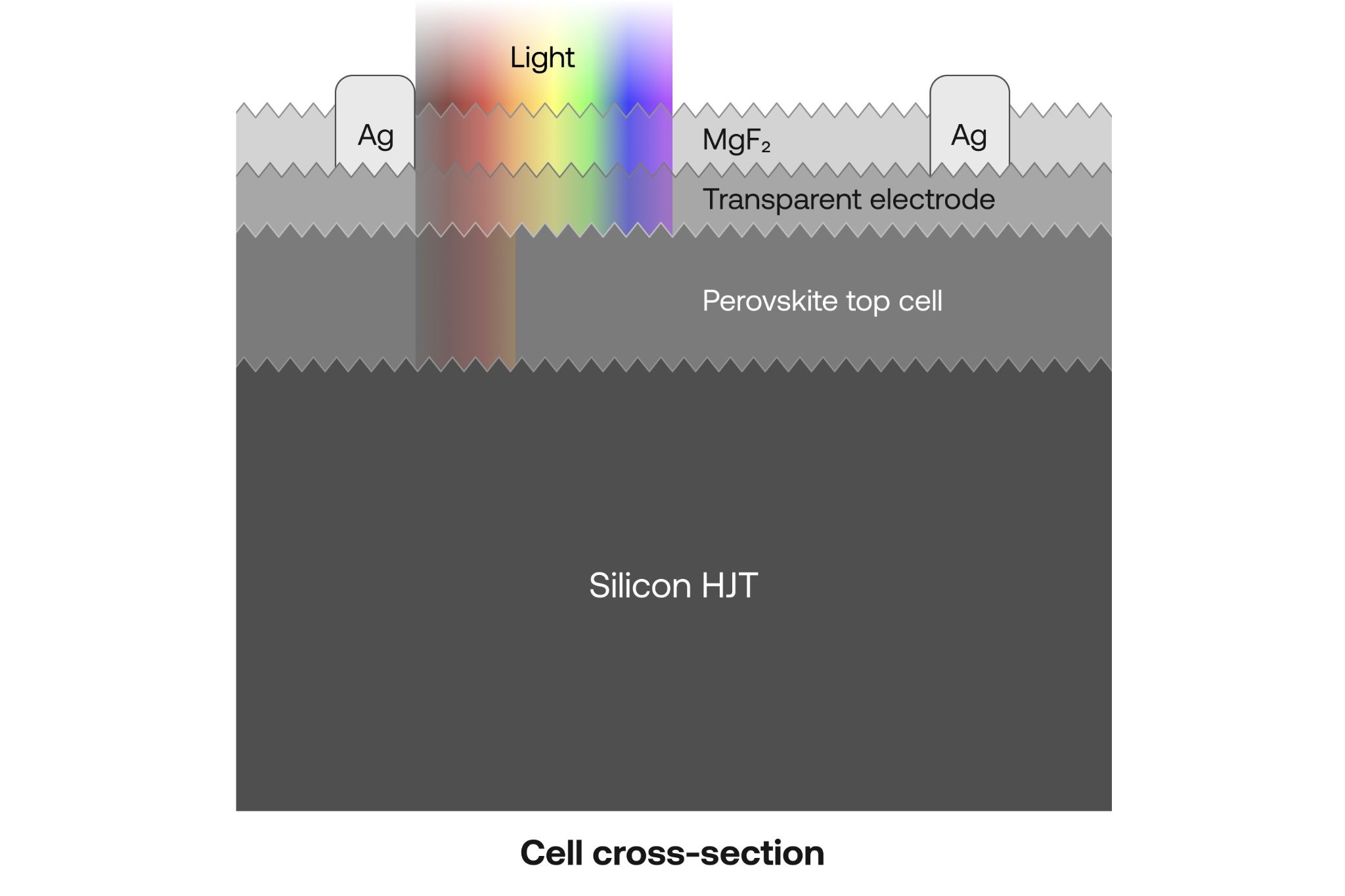
Because of this structure, the silicon cell becomes the electrical and manufacturing foundation of the tandem module. Its voltage, surface structure, stability, and manufacturing process all influence how well the tandem performs. The big question, then, is which silicon technology offers the strongest foundation.
HJT offers six major advantages that make it the clear choice for building perovskite tandem cells.
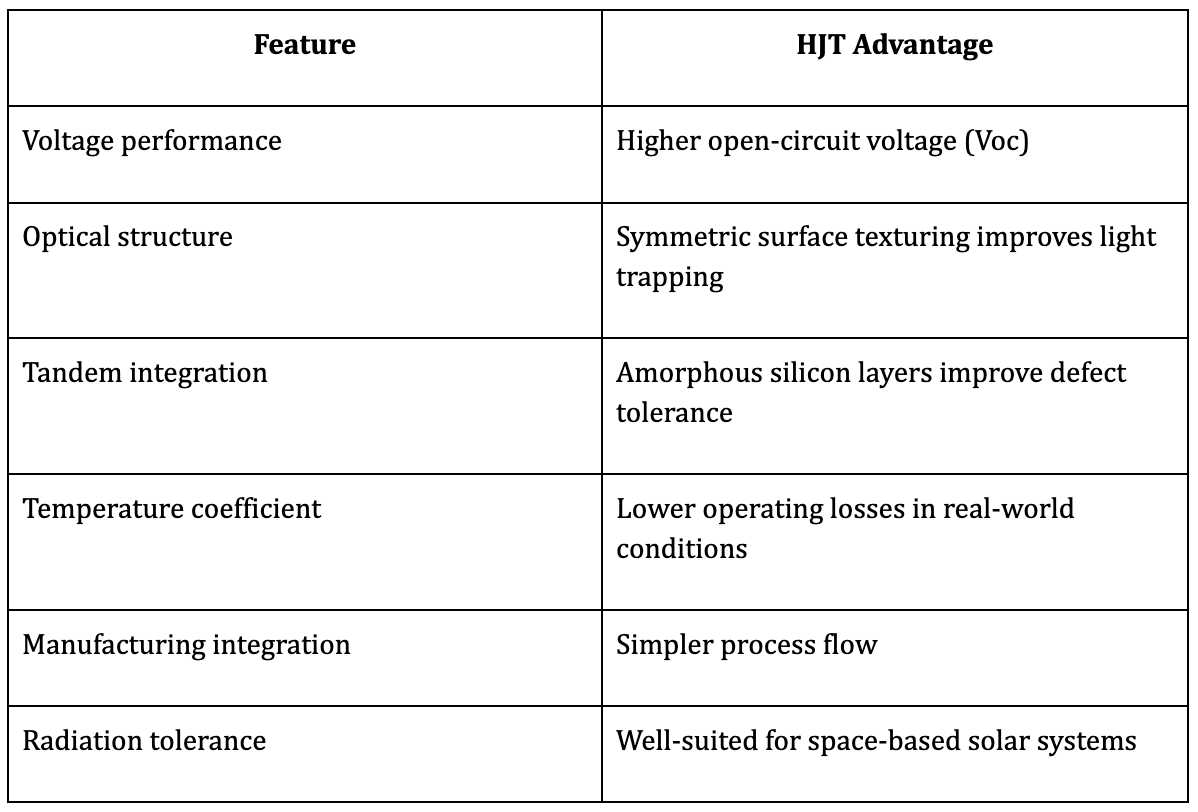
When you add a perovskite top cell to an HJT cell, you unlock higher efficiencies from the HJT cell’s amorphous silicon passivation layers. The perovskite top cell absorbs higher-energy photons, so the HJT bottom cell benefits from voltage gains without the light-absorption tradeoffs present in single-junction HJT cells.
Modern solar cells rely on microscopic surface textures that trap incoming light and reduce reflection. These pyramid-like features help maximize light absorption inside the device. While today’s TOPCon cells only have this texturing on one side, it’s etched on the front and back of HJT cells—allowing HJT to trap even more light when paired with a perovskite top cell.
Combined, we estimate that the excellent passivation and optical structure of the HJT cell enable up to a 3% absolute efficiency gain relative to alternative tandem structures based on TOPCon bottom cell technology.
Early tandem manufacturing will involve extremely thin perovskite layers, often around one micrometer thick. At these thicknesses, even the tiniest defects can reduce yield.
The amorphous silicon passivation layers used in HJT cells provide electrical isolation between the top and bottom cells, improving tolerance to small defects during early manufacturing ramp-up.
Solar modules operate for decades, so long-term performance is just as important as peak efficiency.
HJT cells have lower temperature coefficients and lower degradation rates than many other silicon architectures, including TOPCon. Panels built on HJT technology maintain higher efficiency under real operating conditions and lose less performance over time.
When paired with perovskite layers in a tandem configuration, these characteristics can translate into higher lifetime energy production for solar projects.
HJT production is simpler than TOPCon production, involving fewer steps.
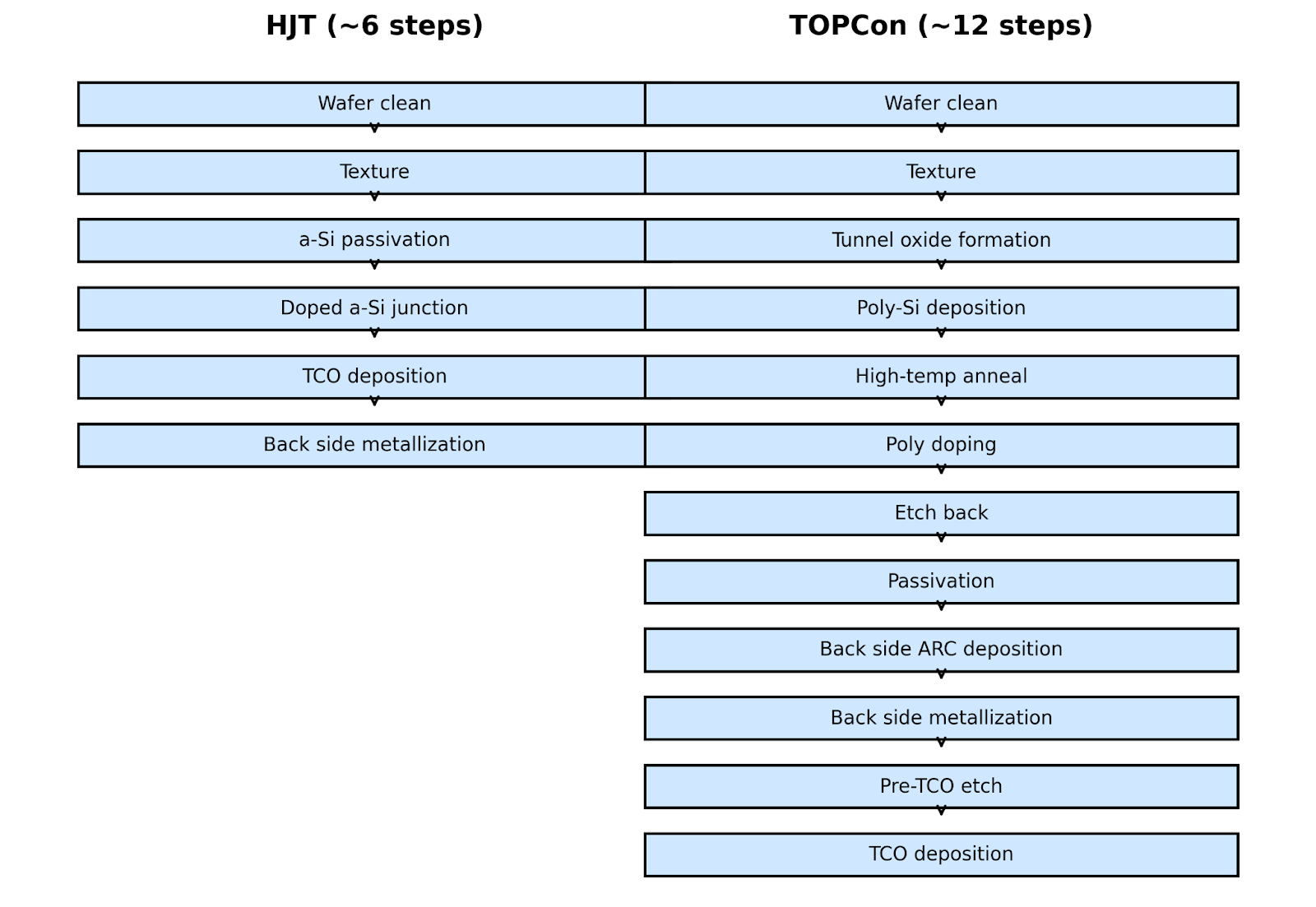
Even better, many of those steps naturally align with the processes for adding a perovskite top layer, from shared use of physical vapor deposition to similarities in how wafers are transferred in production.
Integrating tandems into HJT manufacturing, then, will require fewer new tools and process modifications. As the industry transitions from single-junction silicon to tandem modules, this type of manufacturing alignment becomes increasingly important.
Certain HJT cells—p-type, or p-HJT—boast stronger radiation tolerance than TOPCon, opening the door to use in space-based applications. That means HJT-perovskite tandem cells could power today’s satellites—and even tomorrow’s orbiting data centers and solar farms.
Plus, switching production from one HJT cell type to another doesn’t require major equipment changes. That means a manufacturer can easily make both p-type and the more common n-type, even in the same factory.
Solar energy has grown into one of the fastest-expanding sources of electricity in the world. Continued progress will depend on technologies that deliver higher efficiency and stronger energy yields.
Perovskite–silicon tandems are widely viewed as the next step in that evolution. Choosing the right silicon platform will play a major role in how quickly the industry reaches that future.
HJT technology combines high voltage performance, favorable optics, streamlined manufacturing, and strong field reliability. Together, these characteristics make it a natural match for perovskite tandems.
By pairing this silicon platform with advanced perovskite materials, the industry can move closer to the next generation of high-efficiency solar power.

