
This year Swift started shipping solar cells to American space customers. We are delivering silicon heterojunction (HJT) cells today and building our higher-power perovskite-silicon tandems on the same gigawatt-proven foundation—same size, same weight, more power.
Solar is the only practical power source for satellites, and space solar is having its utility-scale moment—the birth of a new industrial market akin to terrestrial solar in the late 2000s, when it grew from cabins, calculators, and military outposts to massive industrial infrastructure measured in gigawatts. As a species we have launched ~100MW of solar photovoltaics into space—historically small but mighty PV cells and arrays powering expensive one-off satellites, civilian and government. Now solar is powering large-scale space infrastructure, from massive telecom constellations like Starlink to orbital data centers (coming soon).
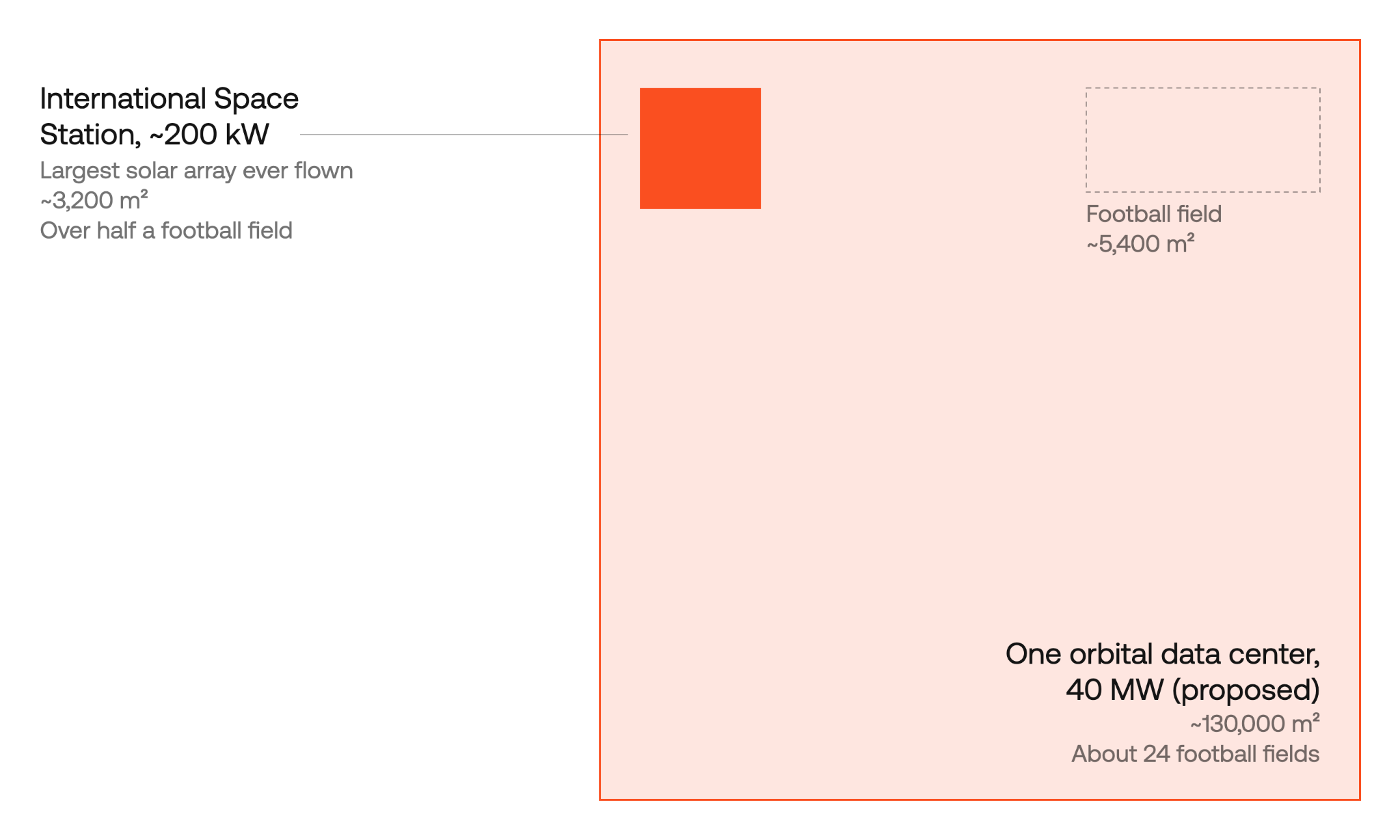
The sci-fi nerd in me gets excited at this point, dreaming of Dyson spheres and Kardashev Type II futures. Space solar has virtually unlimited potential (10^26 W) and will power humanity as long as we stay in this solar system. Cheap power on orbit will unlock orbital compute and other exciting things like asteroid mining, power beaming, manufacturing in microgravity, and more.
Silicon cuts the cost per watt of space cells by more than 99% compared with traditional III-V cells. Terrestrial gigawatts made silicon cheap, and it’s now the standard for satellite constellations. Satellite builders also need more power to deliver better services—more data, more bandwidth, more inference compute, more intelligence—and they need that power on day 2,000 as much as on day one. Bigger, heavier panels translate to higher launch costs and design complexity. So what really matters is (1) system cost per watt and (2) power per kilogram at end of life (EOL). More efficient solar solves for both.
Looking one level deeper, most silicon-powered constellations have been making do with PERC, the workhorse of terrestrial solar until 2024. A better option is already available—silicon heterojunction technology (HJT) offers a higher initial efficiency (~25% vs. ~23% AM1.5) and better high-temperature performance (–0.25%/°C vs. –0.35%/°C tempco). Together, that means ~10% more power on orbit at beginning of life (BOL). Thinner HJT cells can hold more of it through EOL (semiconductor physics; call me if you want to nerd out) and reduce weight. That’s why space companies are now switching to HJT.
At Swift, we make solar, not satellites. A few satellite makers want to build their own cells, and we can help. Most need a dedicated supplier that won't compete with them. And because we're scaling the same technology for Earth, we’re building toward GW-scale volumes for space too.
On the heels of HJT come perovskite tandems, which add a perovskite layer on top of our HJT cells to deliver 20%+ more power. Swift has been readying perovskites for space through over 5 years of patient R&D. We and our collaborators have published 10+ papers on perovskite technology for space, including foundational work on radiation tolerance, self-healing, and high-temperature operation.
We started flying perovskites in 2023 and have completed 3 low Earth orbit (LEO) test missions with surprising early results. We expected our early-generation cells to degrade rapidly, but single-junction perovskite cells on our longest mission showed no meaningful efficiency loss over 7 months on orbit. That's over 3,000 sunrises. While not yet proof of LEO-relevant lifetimes or readiness for mission-critical systems, this is an important step toward the next generation of space power. Now we’re gearing up to fly full-size tandems.
Please reach out at partner@swiftsolar.com or message me on LinkedIn to get test cells, secure HJT supply for your upcoming missions, and discuss tandems for future missions.
–
About Swift
Swift Solar makes high-efficiency silicon heterojunction and perovskite tandem solar products for Earth and space. Our mission is to unlock the full potential of solar energy.
Photo credit: Stephan Floss

