
Building a better solar cell is a learning exercise.
Change a process condition or material. Fabricate, measure, and characterize the device. Get the results, analyze and interpret the data, and move on to the next experiment.
At Swift Solar, our team has spent nearly a decade repeating that learning cycle—first developing perovskite tandem solar technology, and now moving it toward commercial manufacturing. We’ve accumulated years of experimental and process data, created increasingly structured R&D workflows, and developed deep technical knowledge of the challenges that stand between an idea and a product.
Now, we’re using AI to build on that foundation.
The question we aim to answer, and what this series will explore, is simple. How can we learn more from every experiment and reach the right answer faster?
Why experimentation takes time
In materials R&D, progress is governed by the learning rate: How much useful information a team can extract from the experiments it has the time and resources to run.
On Swift’s R&D line, it generally takes 24 to 72 hours to complete a full design-build-measure-learn loop, while long-term stability testing can stretch weeks or months.
When experimentation takes that long, how much you learn from each turn of the loop matters.
Traditional experimental campaigns often explore a range of conditions systematically. That approach is essential to R&D, but not every experiment is equally informative. A campaign may spend too much time within parameters the experiments have already mapped, test differences that are too small to distinguish from normal measurement noise, or identify the most promising combination of variables late in the sequence.
When physical experiments are expensive and time-consuming, every unnecessary turn consumes materials, equipment capacity, and time that could be directed toward another question. Figuring out which experiments are most likely to move the work forward is key.
That’s where Wayfinder—Swift’s self-driving lab platform—comes in.
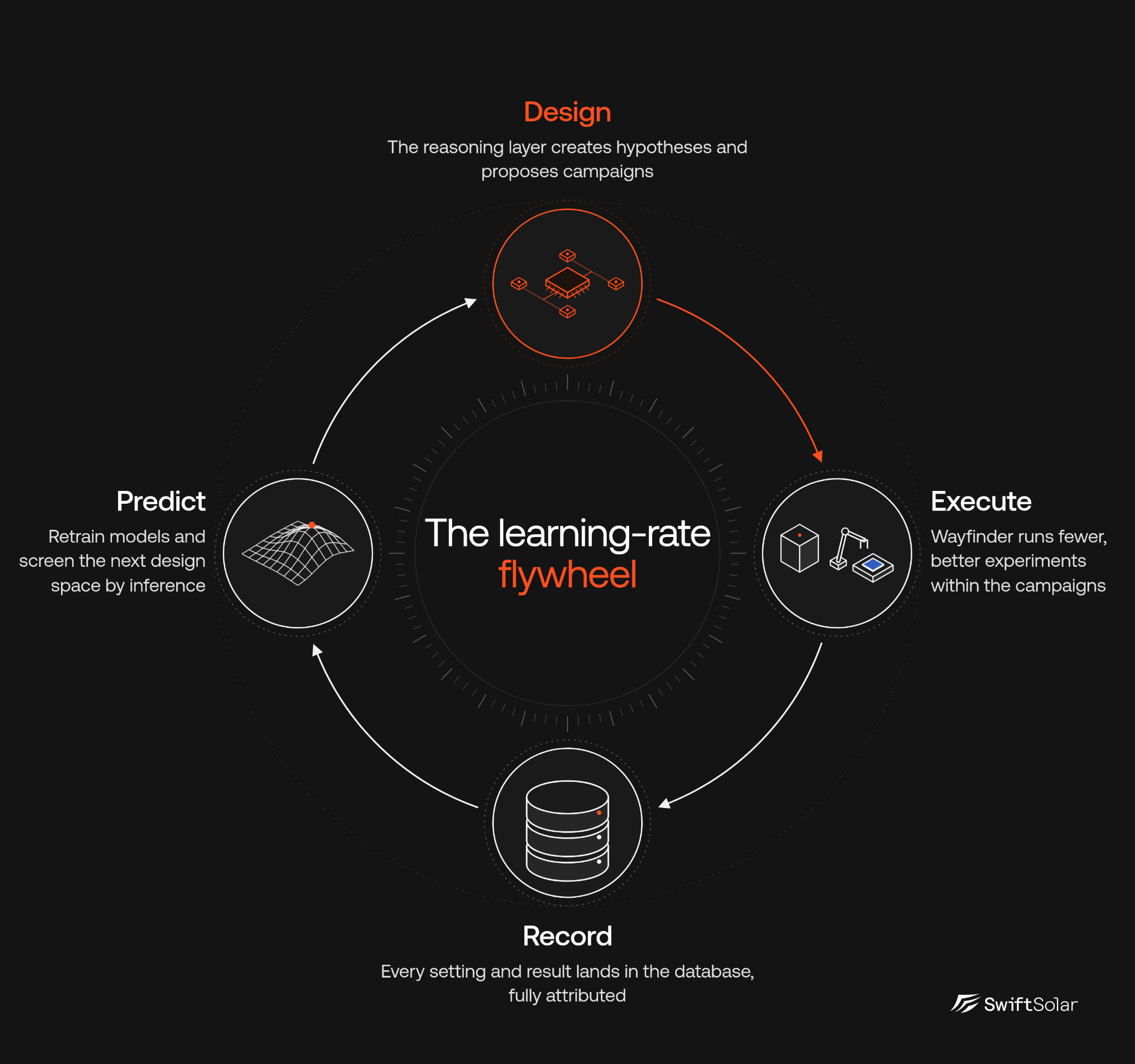
Wayfinder: Making every experiment count
We built Wayfinder to extract as much useful information as possible from each turn of the loop.
Swift’s scientists define what they want to optimize and the range of conditions that are safe and scientifically worthwhile to explore. Wayfinder then recommends a batch of experimental conditions within those boundaries. Technicians run the experiments, and measurements flow back into Swift’s data systems. Wayfinder uses those results to update its model and recommend the next batch. If it encounters an anomaly or moves into a region where uncertainty is high enough to matter, the decision comes back to the team. Then the process repeats. The result is a closed experimental loop in which each round of results helps determine what to test next.
Rather than trying every possible combination, Wayfinder weighs what it has already learned against where uncertainty remains and uses that information to recommend the next experiments.
Testing Wayfinder against ourselves
Any system designed to improve scientific decision-making needs to be tested against real results. We identified five optimization campaigns within a 12-month period of our own process history and replayed them virtually to see how Wayfinder compared.
The largest improvement came in a two-dimensional campaign with 310 unique experimental conditions. Swift’s historical sequence reached the optimum after 201 conditions. Wayfinder reached it in 17—an 11.8× reduction. In another large campaign, it required 19 conditions compared with 116 historically.
Importantly, Wayfinder did not outperform every comparison strategy in every campaign. Across multiple Swift campaigns, however, we found that a system learning from each round can reduce the number of physical experiments needed to reach an answer.
When one experimental loop takes days, those savings add up quickly. In the campaign where Wayfinder demonstrated the largest improvement, saving 184 experimental conditions, we estimate that difference represented more than six weeks of total line capacity—potentially longer when loops run serially.
Building on the Wayfinder loop
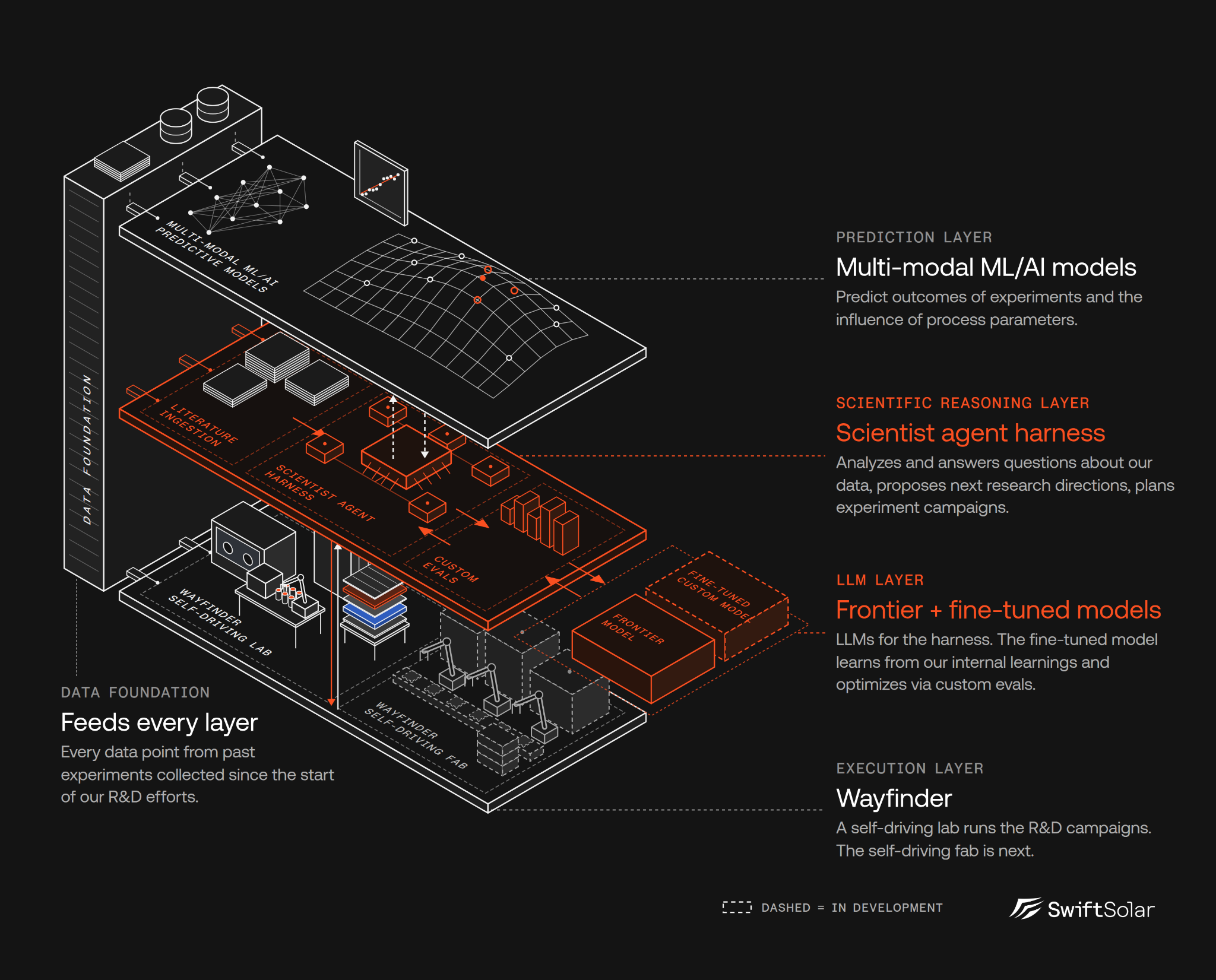
Wayfinder is just one element in Swift’s full scientific AI stack, which combines proprietary data, experimental infrastructure, and deep domain expertise around commercializing perovskite tandem solar. We're building three connected capabilities:
To empower the reasoning layer, we built a chat interface specialized for data analysis. Our researchers get a primary window to deep data science and expert analytics, while behind the scenes, an agent harness uses specialized tools integrated directly into our core database. This setup allows our scientists to independently perform complex data science tasks and create their own automated analyses, eliminating analytical latency and delivering a true 0-to-1 shift in scientific productivity.
Before we built this system, some analyses sat in the queue at risk of abandonment. Now they happen automatically, reducing months-long waits to just a few days.
Once researchers can interact with multi-dimensional data fluidly, they naturally start to ask fundamentally different, higher-order questions. As illustrated in our system architecture, when this capability is combined with a filtered literature library and tuned agent orchestration, the platform goes beyond simple analysis into active hypothesis generation. The reasoning layer can also configure and launch new experimental campaigns directly in the execution layer. This connects AI-generated hypotheses with physical testing on Swift’s R&D line.
From the self-driving lab to the self-driving fab
Swift’s AI stack is helping our scientists start with better questions, reach an answer in fewer physical experiments, and—in the best case—predict outcomes without even running an experiment. As we move from R&D toward commercial manufacturing, the value of this system grows.
On the bench, physical experimentation is slow. Scientists often have time to interpret one batch of results before the next full learning loop has finished. In high-volume production, the constraint flips.
Highly instrumented manufacturing equipment can generate large volumes of process and performance data continuously. With in-line measurement at multiple points in the process, a production line can generate data faster than a human team can analyze it and decide how to respond.
The same basic closed loop behind Wayfinder—propose, execute, measure, learn—extends into the manufacturing environment, or what we call the self-driving fab. Wayfinder is the prototype. The tools and workflows will change as the laboratory becomes a production line, but the core logic remains the same: Use measurements from the physical process to improve the next decision, while maintaining clear objectives, design bounds, and traceability.
Why this matters for Swift
There is enormous interest today in using AI to discover new materials. Companies including Lila Sciences and Periodic Labs are building systems that connect AI directly to automated experimentation, while Discovery Loop, co-founded by Swift Solar investor Jeff Dean, is developing AI systems that generate and learn from new experiments. Major AI companies including OpenAI, Anthropic, and Google are also developing tools specifically for scientific research.
That work will be important. But finding a promising material is only the beginning of commercialization. There’s still an inherently physical element to the process.
A new solar technology has to be optimized, made repeatably, tested for performance and stability, transferred onto production equipment, and manufactured consistently at high volume. Those steps involve thousands of engineering decisions and physical experiments, traditionally carried out over a decade or more.
That is where Swift is concentrating its AI work. Swift's focus is on learning more from physical experimentation and carrying the insights from R&D into manufacturing.
Throughout this series, we’ll go deeper into the systems we’re building to increase that learning rate—from Wayfinder and our self-driving lab, to predictive models, scientific reasoning tools, and ultimately the self-driving fab.
They are different pieces of the same strategy: Run better experiments. Learn more from each one. Carry those learnings from R&D into manufacturing. And shorten the path to commercially-manufactured tandem solar.

