
This is Part 1 in a series on manufacturing solar in the US.
Who gets to decide how much Americans pay for electricity over the next 30 years—the United States or China? The answer will be determined by where solar technology is manufactured.
Electricity demand in the US is accelerating at a historic pace. AI, industrialization, and the electrification of everything are speeding up the race to deploy new power. If we can’t keep up, it will constrain economic growth.
There are many ways to add large amounts of new energy generation. Yet few can meet today’s urgent need for more power. Gas turbines are burdened by multi-year backlogs. New nuclear is a decade from reality. Enhanced geothermal is promising, but far from deployable at scale.
Solar deploys faster than any other large-scale energy source, is the most versatile, and now delivers the lowest-cost energy to the grid.
If the US wants to expand power supply to enable economic growth and the buildout of AI, we need solar to scale further and faster, and we need it to be American-made.
CHINA’S CONTROL OF SOLAR MANUFACTURING
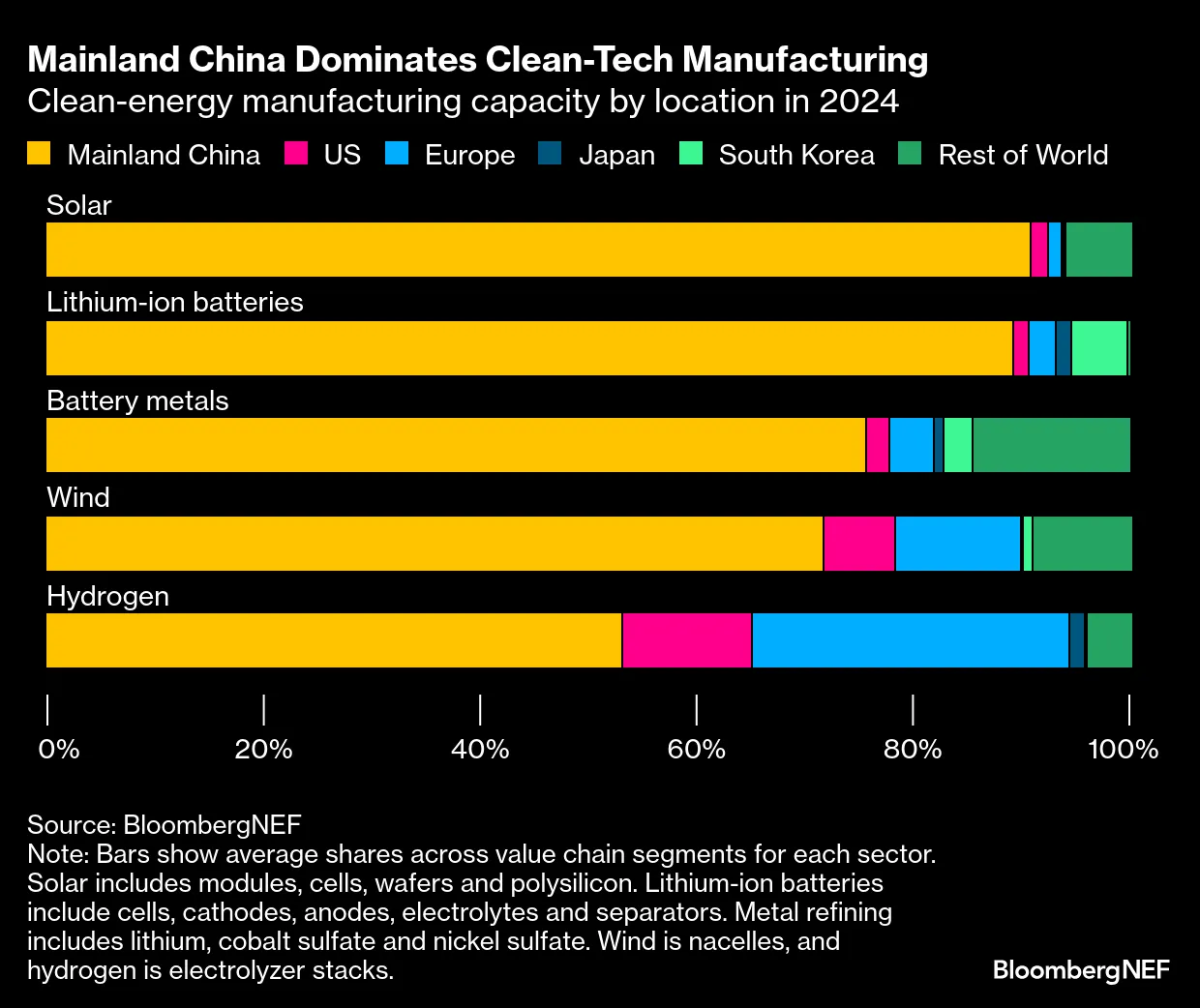
Today, China dominates global solar manufacturing. Across the entire supply chain—from polysilicon to cells to modules—China controls roughly 90% of global capacity.
This has exposed a profound vulnerability for the US.
Allowing a single foreign power to dominate global production of the cheapest, fastest-to-deploy energy technology in the world is an economic and national security risk. The US has already seen how supply chain dependence can be weaponized, whether through export controls on critical minerals or concerns about embedded hardware risks in grid-connected equipment.
We would never accept this level of dependency in automobiles, GPUs, or defense systems. Electricity should be no different.
The US has the technical innovation, capital markets, and industrial base to build a secure solar supply chain—but we won’t succeed by fighting today’s battle for the cheapest silicon PV.
WINNING REQUIRES LEAPFROGGING
Competing head-to-head with China on silicon PV is not a winning strategy. China has spent decades building manufacturing scale, driving down costs through state sponsorship, and optimizing their solar supply chain for dominance.
Beating China requires technological leapfrogging—and next-generation perovskite solar gives us the opportunity to do it.
By pairing perovskite materials with silicon, perovskite tandems unlock much higher energy performance than today’s silicon-only modules. And as we scale production of perovskites, we can drive costs below today’s modules.
Perovskites will reset solar manufacturing and solar supply chains. They rely on new materials and manufacturing processes, which can be easily sourced and scaled domestically or through allied supply chains.
The companies that commercialize this technology and secure their supply chains first will define the next generation of solar manufacturing—and capture a disproportionate share of an energy market that is growing faster than any other in history.
The question we should be asking ourselves is no longer whether perovskites can work, but whether the US will move fast enough to beat China and become a net-exporter.
MANUFACTURING IS ECONOMIC POWER, TECHNOLOGICAL POWER, AND GEOPOLITICAL POWER
Secure, affordable power is essential. Yet it’s hardly the only benefit we’d reap from rebuilding solar manufacturing in the US.
In 2025, global solar investment is expected to hit $450 billion according to the IEA, while deployment approaches terawatt-scale. Manufacturing the technology at the forefront of that market would steer huge shares of that investment toward the US, driving growth into regions that need it. It would create high-value employment across critical materials, semiconductor equipment, and advanced manufacturing.
And those American workers making state-of-the-art solar products would help unlock groundbreaking technological advances here at home, keeping the US at the forefront of global innovation. Moreover, it would reassert American leadership in one of the most strategically important industries of the 21st century, allowing the US to export both technology and geopolitical influence.
Swift Solar is one of the leading US companies that can turn this vision into a reality.
HISTORY RHYMES
The United States has faced this kind of challenge before.
In the mid-20th century, global oil markets shifted away from US control with the rise of OPEC and the oil shock of the 1970s. But US fracking and horizontal drilling innovations eventually reshaped market control. With private capital and supportive policy, the US secured its supply chain and became a net exporter of oil and gas.
The US solar industry now stands at a similar inflection point. Perovskite technology gives the US a chance to retake control of the most abundant energy asset by innovating breakthrough energy technologies at home and building a strong manufacturing base for them to thrive.
With the strength of our investor base, a made-in-America policy framework—including the 45X advanced manufacturing tax credit—and world-class engineering talent, the conditions for success are in place. What remains is the race to scale.
In the next post, we’ll examine what it will take to build a resilient, scalable solar supply chain in the United States—and why manufacturing innovation is the key to leapfrogging at scale.
# # #

